case study
Your Ford Ambassador
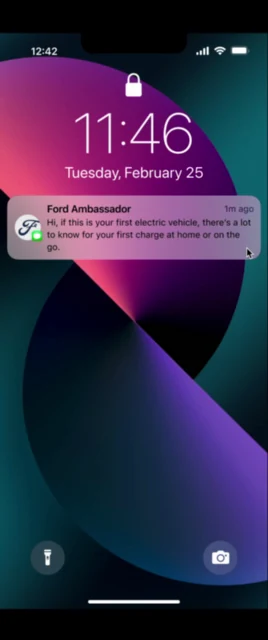
Ford is betting big on electric vehicles. Your Ford Ambassador is a text-based guide that walks new Mach-E and F-150 Lightning owners from order to first charge.
Challenge
make ev ownership feel human
Buying your first EV comes with a whole new set of questions. Do I need a wallbox? What's the difference between a 120v and 240v outlet? Where do I charge on a road trip? Most customers were answering these on YouTube, waiting months for delivery with little communication, and dealers weren't always able to help.
As Director of XD Strategy on Ford's Ownership team, I led the program from evaluation through pilot and scale, working across Design, Operations, IT and a partner customer-care team.
Start with the journey
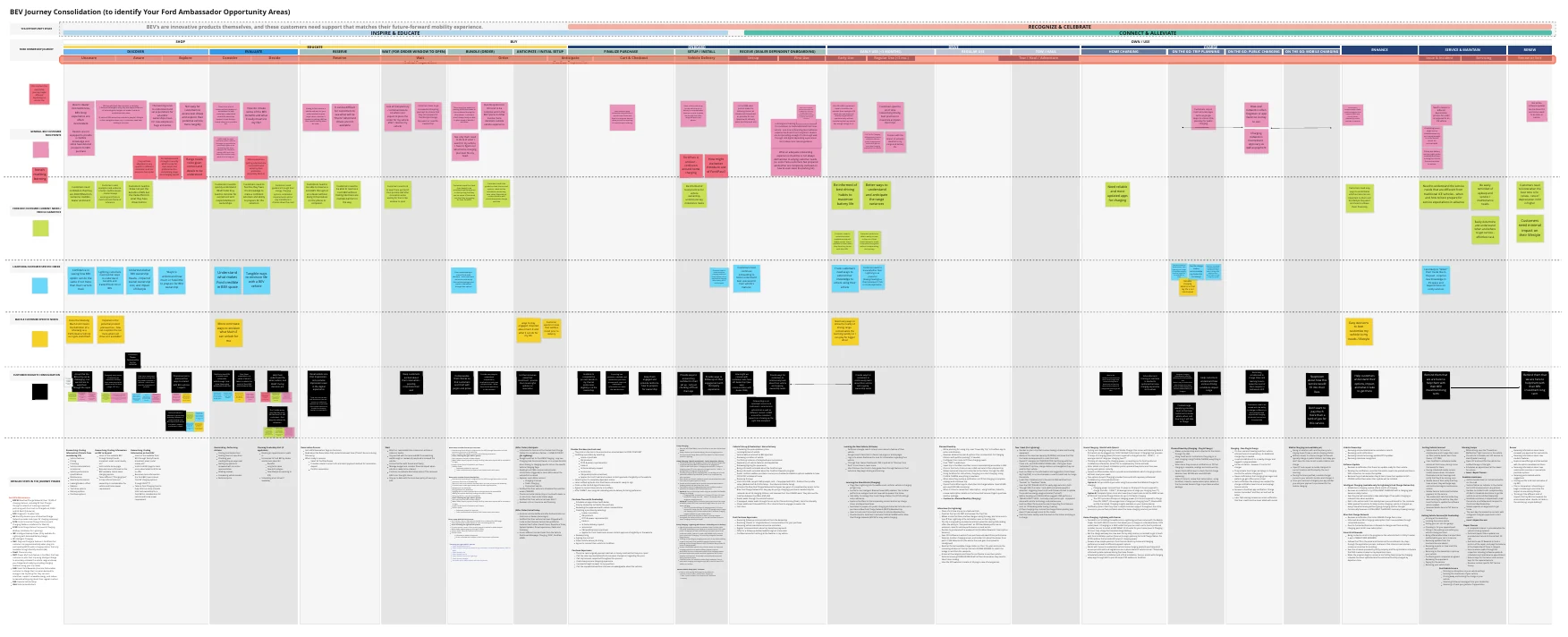
Before designing anything, the team consolidated everything we knew about EV ownership, from first awareness through shopping, reserving, waiting, delivery, early use and service, for both Mach-E and Lightning owners. A few pain points kept showing up. The learning curve was huge. The wait between reservation and delivery was a black box. Dealers were inconsistent, and home charging was confusing.
Lightning owners wanted to know whether towing would kill their range. Mach-E owners wondered whether an electric Mustang is still a Mustang. The theme that tied it all together: contextualize everything for the customer.
Scroll to explore →
Above: The EV journey consolidation mapped customer pain points and needs across every phase, from discover to renew, and identified where an Ambassador could help most.
Looking outward
We interviewed dealerships to understand what was actually happening on the showroom floor and at delivery. We also evaluated three best-in-class support experiences: Rivian, VW and Apple Support. The best ones felt less like a help desk and more like a knowledgeable friend who reaches out before you have to ask.
Meet them where they are
That led to one of our biggest decisions: no new app. Customers already live in their text messages, so the Ambassador would too. Signing up took a first name and a phone number, and a real person would text you within 48 hours.
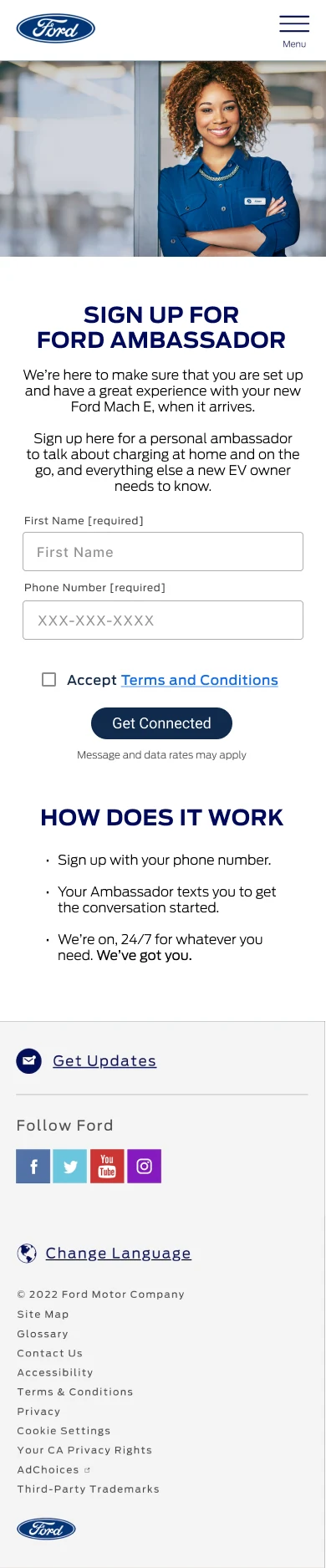
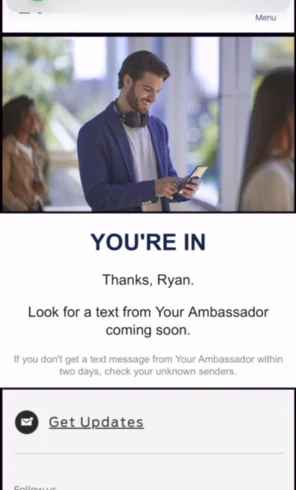
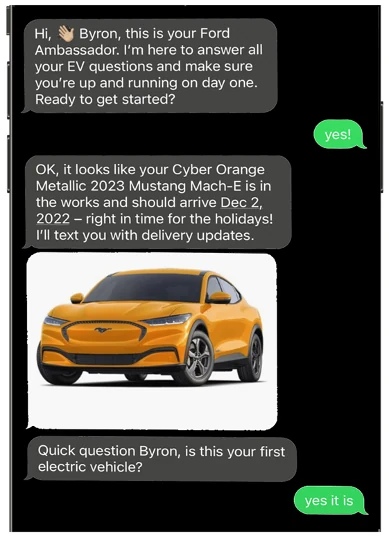
Above: Sign-up asks for only what we need. Within 48 hours your Ambassador introduces themselves with a picture of your actual vehicle and its expected delivery date.
The right moment
Timing turned out to be as important as content. Rather than giving a new owner everything at once, we mapped each conversation to a moment in the order-to-delivery journey, so customers got the right information when they actually needed it.
Prototype, test, repeat
We ran three rounds of prototype testing with EV owners and EV intenders. The prototypes weren't clickable screens. They were real text conversations sent to participants' own phones, so we could see how people reacted to a message from their Ambassador in the middle of their day.
One conversation became the core of the experience: home charging. Participants told us which outlet they had, saw how long a full charge would take, and could buy a Ford Connected Charge Station and book an installer, all without leaving the thread.
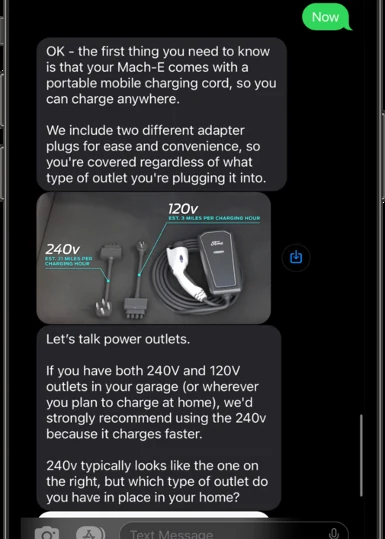
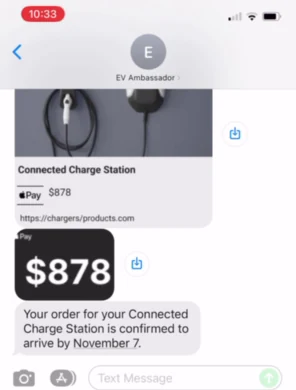
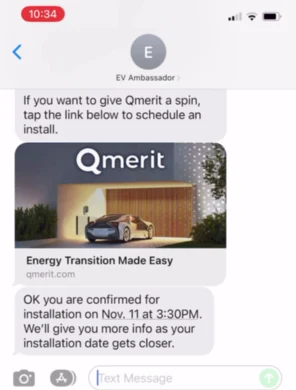
Above: The prototype home charging conversation. Identify your outlet, understand charge times, buy a charge station and schedule an installer, all in one thread.
What we heard
Three themes came up again and again in prototype testing.
The Ambassador builds trust
Essentially I’m talking to the mothership. It makes sense that you would help me find an answer to a problem.
“Always on” is a big win
If the call center schedule doesn’t align with my schedule, this is great to have.
Help with charging helps greatly
I don’t know anything about electricity. I’m thrilled that they’re saying order this, schedule this, call this guy.
A voice with principles
A human service only works if every agent sounds like the same thoughtful person. We wrote principles, a style guide and a toolkit for the Ambassador team.
- Be friendly, be yourself
- Simplify complicated concepts
- Celebrate big moments
- Answer in the thread, not with a bunch of links
- Track down answers and follow up
- Use FordSpeak or acronyms
- Paste raw specs with no context
- Rapid-fire texts at people
- Reply “I don't know”
- Make customers work for it
Designing the backstage
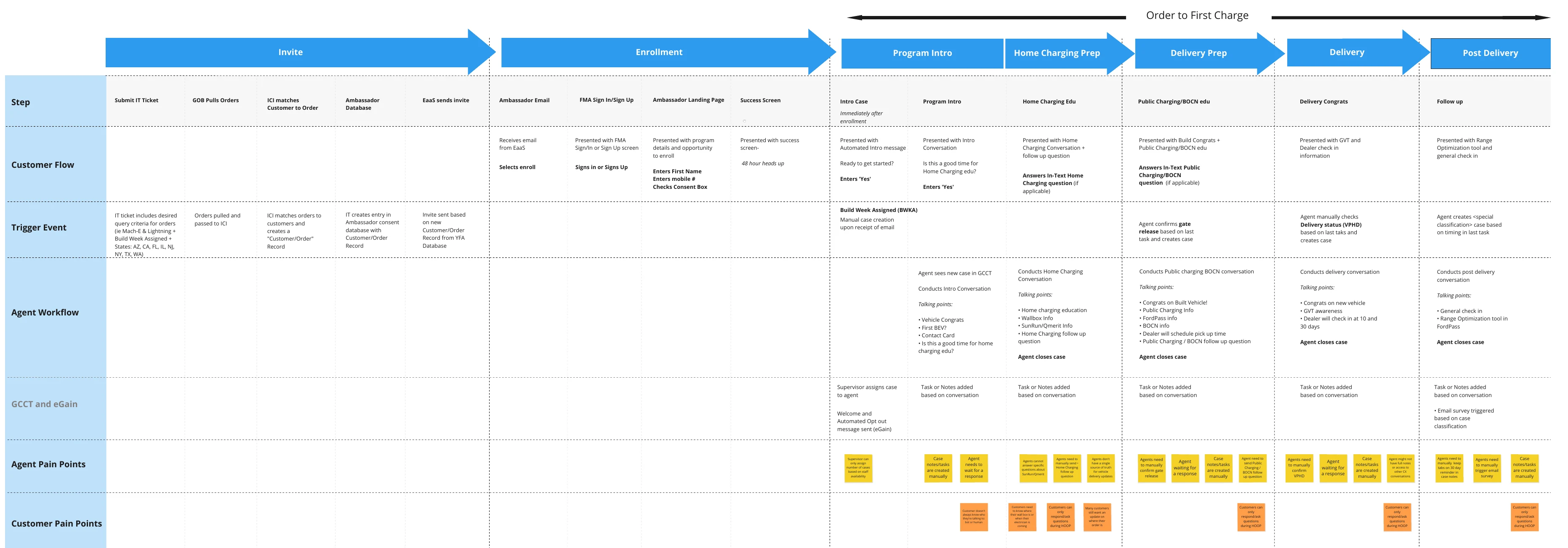
The friendly text thread was the part customers could see. Behind it sat order systems, a consent database, a CRM, email services and a team of agents. To make it work I built a service blueprint for the full order-to-first-charge journey, showing what the customer sees, what triggers each conversation, what the agent does, and where things break.
The blueprint was candid about the pain. Agents created case notes by hand, checked delivery status manually and had no single source of truth for where a vehicle was. Customers could only get answers during business hours and weren't always sure whether they were talking to a person or a bot. Those pain points became the roadmap.
Scroll to explore →
Above: The YFA service blueprint, from invite and enrollment through post-delivery, with customer flow, triggers, agent workflow and pain points for both agents and customers.
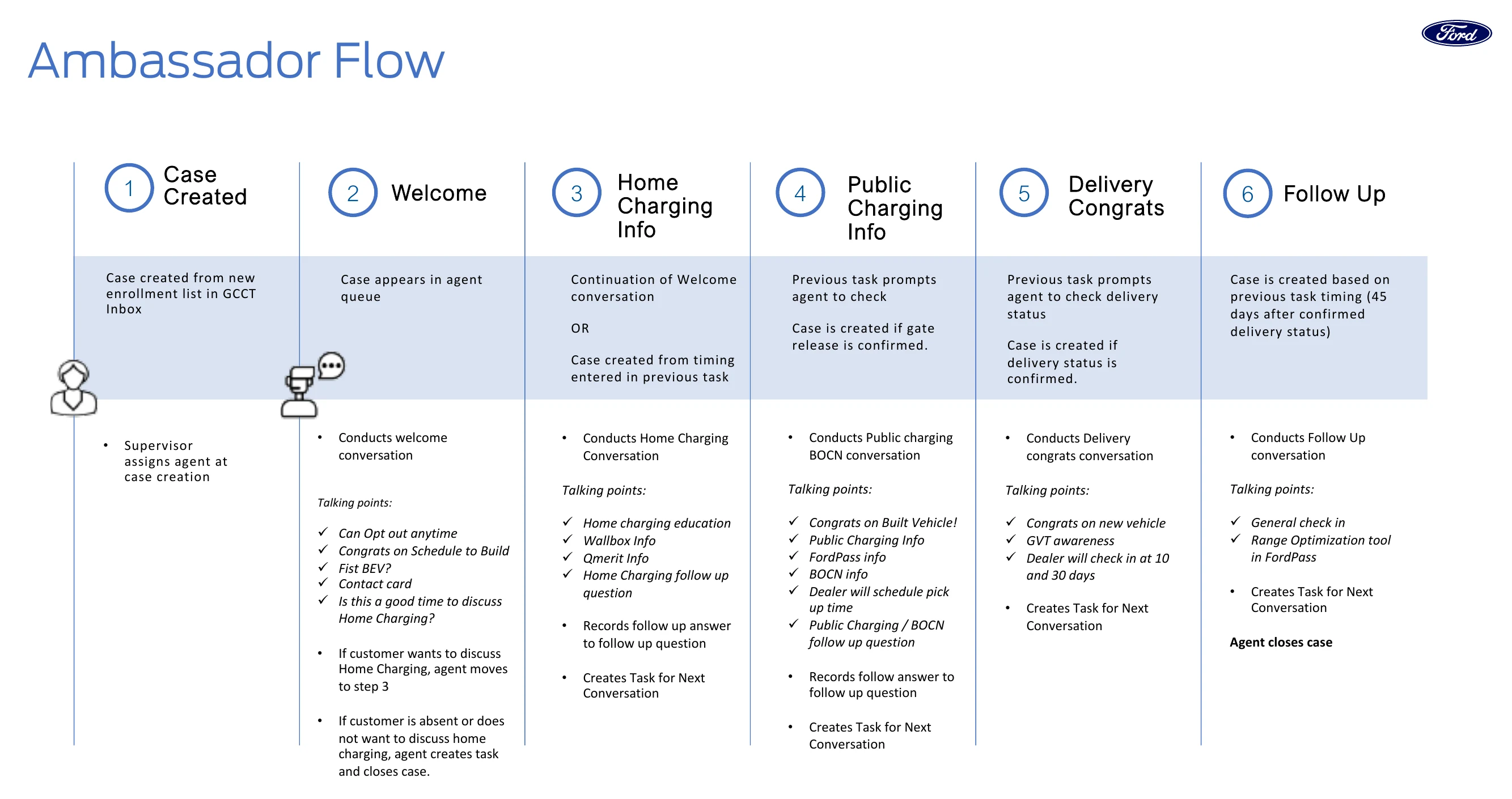
Above: The agent flow turned the journey into six cases, each with talking points and a task that kicks off the next conversation.
Pilot first, then scale
We partnered with Percepta to stand up a dedicated Ambassador customer care team, and wrote a pilot delivery plan that brought Experience Design, Operations and Development together to launch a small-scale version of the program. The pilot invited Mach-E and Lightning customers in eight states as soon as their vehicle was assigned a build week.
We deliberately started manually. Order data was pulled by hand, cases were created by a supervisor and every conversation was tracked in case notes. Once the experience was proven, we automated it one step at a time: order data flowing in automatically, then automatic case creation, then every follow-up conversation triggered by the customer's progress.
What it became
Later iterations moved the Ambassador into a branded Ford messaging thread and leaned into the big moments: a celebration when your Mach-E rolls off the line, live delivery tracking, and your dealer's address when it's ready for pickup.
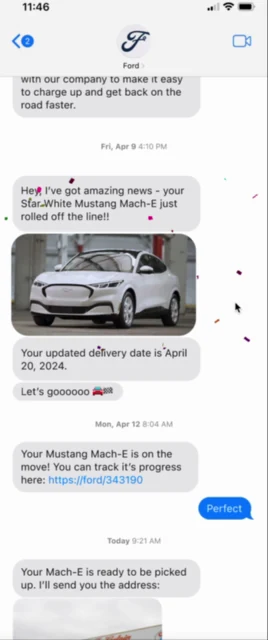
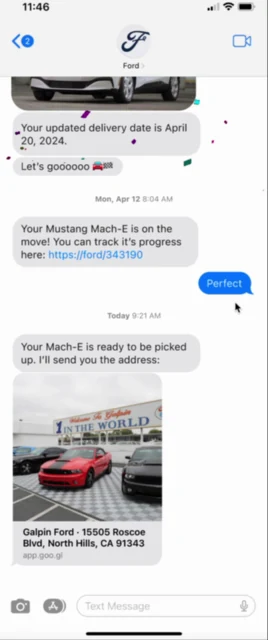
Above: A later version of the experience in a verified Ford thread, celebrating the build and guiding the customer to pickup.
Your Ford Ambassador is now live under the new name Ford Advisor in Ford's 24/7 Live Support product.
Key learnings
A text from a person beats a feature in an app. Customers didn't want another download. They wanted someone they could ask.
Timing is the content. The same message lands very differently at order, at build and at delivery.
Design the backstage as carefully as the front. The service blueprint did as much to shape the experience as any screen.
Start manual, automate what works. Running the pilot by hand showed us exactly what was worth automating.
Principles scale better than scripts. Four memorable principles gave agents room to be human and still sound like Ford.